Our transhumanist future?

I have a large external memory, enhanced time-keeping sense and improved vision. At least when I have an internet connection, my phone or watch and glasses. But I don’t mean to stop there for the rest of my life. You could say I’m a transhumanist.

I must admit I’m considerably more interested in the scientific and technological side of transhumanism than its philosophical implications – and also in the short-term visions rather than far-future goals. Because if you think about it, it’s already been here for some time. Actually for a very long time if you count somewhat crude enhancements like glasses or walking sticks. But these things have only been improving the existing conditions of human nature, not substantially altering them. Only recently, we’ve got people who can hear color or wi-fi signals, sense magnetic fields or add extra mechanical fingers to their hands.

What’s more, none of these things are particularly unavailable. The Cyborg Foundation, founded by Neil Harbisson and Moon Ribas in 2010, offers to help people become cyborgs, be it with the eyeborg devices or something else. Their aim is to make the technology available for everyone interested in it. And while Frank Swain needs his cochlear implant to hear wi-fi, I can imagine implementing it through an attachable device similar to the eyeborg. Anyone willing to undergo the pain of the procedure and some risk of inflammation can have a neodymium magnet implanted in their fingertip. Bionics are on the expensive side so far but with the advent of home 3D printing, who knows how long they stay so, at least in case of minor extensions?

Some of the enhancements so far are still very crude but they offer us new ways of perceiving the world, an extension of our senses. A nice, very civil science-fictional example of such thing is Greg Egan’s “Seventh Sight” from last year’s Neil Clarke’s anthology Upgraded. Egan managed to portray the life of a heptachromatic in a way the reader could very vividly imagine. The era of real heptachromatics may not be too far away, as is the era of completely new artificial synaesthesiacs or many-fingered coders (the motoric control of fast typing with more than ten fingers would be very interesting to observe!). Other enhancements like usage of artificial chromozomes in medicine, haptic suits or advanced cryonics may still be far ahead and remain in the realm of science fiction for a while. And science fiction itself can function as a generator of new ideas and ways to look into the future. SF doesn’t predict the future very well. However, it does something much more interesting. It helps create it.

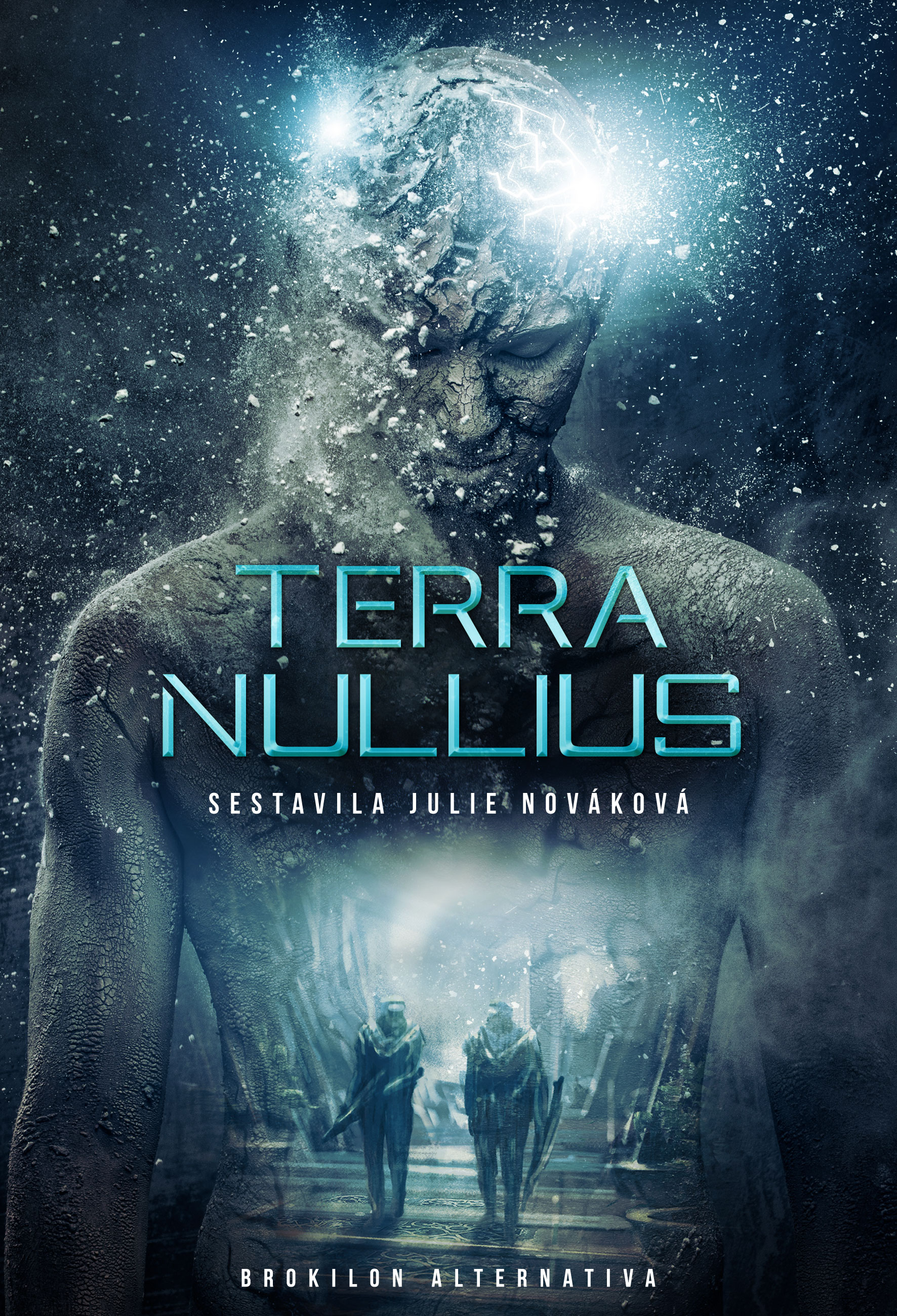
With that in mind and thinking of the long tradition of SF exploring what it means to be a human and how it could possibly change, I began to think of putting together an anthology of Czech stories exploring this vast uncharted space – because though great many authors had tackled it before, most of it still remains a terra incognita. Or, so far, terra nullius – no man’s land. Before someone finds it and claims it, that land wedged between the real and the unthinkable. Before someone gets a weird idea and thinks: “Why not?” Before someone stumbles upon a path unseen by others…

In 2012, I started soliciting stories from authors I knew had a great imagination combined with great skill and knowledge, discussing their ideas and shaping a frame of the anthology into existence. In 2014, it was ready. Now, in May 2015, it comes into the world (with the book launch on May 16 during the Book World festival in Prague), and with it near-future biotechnology and spy agencies; genetically altered crew of the first starship; fight for the rights of artificially designed persons; human-animal brain-to-brain interfaces; spaceships from the future playing havoc with the human psyche; shunned individuals directly communicating with quantum computers; the very first memory transfers between parents and children in times of war; controlling two bodies at once; making a strange journey into alien simulations of Earth’s world… And while Terra nullius is a Czech anthology, I hope at least one or two of its stories make it into English as well.

Terra nullius: may you not remain inaccessible to us forever. Because I see scientists, artists and tech geeks all embracing the vast possibilities of pushing their limits futher, beyond what we had imagined for so long. I see a future where everyone can choose their senses and physical capabilities to some extent, regardless of where they start and what others have. I see DIY geeks pushing the boundaries from their garages and workshops while on the other end of the spectrum, big corporations devote their resources to the similar ultimate goals. I see a society both more individualistic and more diverse and tolerant. And I see the adventures coming with all that in science, technology, art and personal lives… I could be totally wrong, of course, and it could conversely mean greater divides and fewer opportunities, but I remain optimistic. Though I’m sometimes a little on the misanthropic side, I love curiousity and resourcefulness and people who possess them. The drive that gets us into space, into the depths of the ocean, to new questions to answer and new mysteries to solve. Both scientific and artistic curiosity can create a positive feedback loop and bring forth a better future. Don’t think it can happen? Fine. But this is the one I am aiming for. I’m a transhumanist, a technooptimist and a geek. And I hope to walk the terra nullius before us and create a piece of the bright future if I can.
Terra_Nullius_FRONT


News from Academia Film Olomouc & more

Well, AFO turned out great despite some small organizational problems. The films and talks were all interesting. I liked Pohyby (Movements) and Kmeny: Hackeři (Tribes: Hackers) a lot and James Kakalios’ talk on the physics of superheroes was great fun. And he wasn’t afraid to show equations! That always cheers me up. Lawrence Krauss’ “Physics of Star Trek” was also very good but Kakalios was just the highlight. And Richard Dawkins’ lecture on evolutionary arms races was great too. Though not news for the biologists in the audience, it was brilliantly prepared and interesting to hear.

I also hope people liked my talk about subsurface oceans, I’ve had some good feedback. By the way, I do hope I’ll need to revise it substantially after the New Horizons‘ flyby of Pluto…

During AFO, a little experimental piece of mine, “A Different Kind of Story“, was published at Theme of Absence along with a short interview with me. I hope you like it!

And you can expect a post on transhumanism quite soon as the publication date of my anthology Terra nullius draws nearer. The anthology is in Czech but with some luck, you’ll see one or two of the stories in English as well.

In other news, my diploma thesis is finally almost out of my hands which means I have a little time for the blog again (and to write some great science fiction, hopefully). Well, see you here!

Academia Film Olomouc

Just a quick reminder: Olomouc hosts AFO (Academia Film Olomouc) festival next week (April 14 – 19). I’ll be there having a talk about subsurface oceans (Tuesday 16:00) and helping out with my colleagues’ experiments (every day from 10:00 to 12:00, except Saturday). We’ll be able to find out your Rh factor and by later ELISA analysis also the presence (or not) of antibodies against Toxoplasma gondii (if you let the medics in our team take a few milliliters of blood from you). And if we’re not a reason enough to go, Lawrence Krauss and Richard Dawkins are going to be there ;)!

I’ll be fairly busy in the foreseeable future, finishing a diploma thesis, occasionally lecturing, writing or translating articles. You can expect more new posts in June, after my final exams.

To make up for my inactivity here, head to Theme of Absence the next Friday. I shall have a little story out there.

One World festival

Just a quick reminder: One World, the largest human rights documentary film festival, has started yesterday in Prague. There are plenty of films to see about various topics ranging from war conflicts around the world, hacktivism, privacy and cyber security, LGBT and women’s rights, to health, education and much more. It’s impossible to see everything but I’ll be sure to go to at least a couple of the documentaries. If you’re somewhere in the Czech Republic, you’ve got a chance to participate. Everything is subtitled, so both Czech and English speakers can be sure not to miss anything because of language barriers. This year’s festival ends March 11.

“I’d love to see first contact with an alien civilization!”

It’s been a while since I posted snippets from interviews I had done for XB-1 here but I can finally share another short excerpt – with the wonderful Ken Liu as the interviewee! His highly anticipated novel The Grace of Kings is going to be published in early April. In addition, he’s a finalist for this year’s Nebulas! His novella “The Regular” (from Neil Clarke’s anthology Upgraded) and his translation of Liu Cixin’s The Three-Body Problem are among the nominations. I hope he adds even more awards to his already remarkable collection – and most of all that we’ll see more and more great fiction from him, as he’s an amazing author.

The interview had been published last April, so please forgive me it’s a little out of date. If I could have posted it sooner, I would have. However, I believe it’s still as interesting as it had been then. Enjoy!


You recently sold three novels to Simon & Schuster: “The Dandelion Dynasty”, a trilogy loosely based on the mythology of the early Han Dynasty but set in a completely new fictional environment. Can you tell us more about it, especially about the first book titled The Grace of Kings?
The story of the founding of the Han Dynasty is well known in China and much of East Asia, but relatively unexplored in western fiction. My wife and I came up with the idea of writing a series of novel based on those legends, but we wanted to do it in a fantasy setting that is separate from historical China – I find the “magical China” trope problematic and using a historical setting would have imposed too many restrictions. I wanted to strip the story down to its essential mythic components and build up a new world around them; it’s also an experiment for me to interrogate the tropes of epic fantasy, the meaning of history, and the techniques of narrative-as-power. At the same time, I wanted it to be a story that is fun and interesting to read, so there are interfering gods, silkpunk technology, mechanical whales, mythical creatures, battle kites, and other elements that I hope will make for an entertaining read. The Grace of Kings is essentially the story of two men who become friends during a rebellion against an oppressive empire only to turn against each other after victory due to fundamentally incompatible ideals.

You’re most famous for your short stories and novelettes. How was work on your first novels different from writing shorter pieces? Did you come across any unexpected advantages and conversely?

I found novel writing to be a challenge – it required a level of sustained focus and steady effort that was difficult to achieve given my job and family commitments. (One of the main reasons I preferred short fiction was because it was easier to fit short stories in when you had an unpredictable schedule.) But I also got to learn a lot about my own process and about how to impose discipline.

Most of your stories so far are science fiction. What made you choose the genre of fantasy for your novels rather than SF?
I don’t really treat science fiction and fantasy (or other genres) as very distinct. My interest in fiction is in the literalization of metaphors, which is practiced as often in science fiction as in fantasy. Epic fantasy is a particular subgenre I haven’t written in, but it was a good fit for the scope of the story I wanted to tell.

Your works are often based on new fascinating scientific ideas and findings and extrapolate them in a very interesting way. What kind of a scientific achievement would you like to experience in your lifetime? And if you could go back at college and choose the subject of your study anew, would you venture into sciences different than computer science?
I’d love to see actual first contact made with an alien civilization. The transformation of human society that would result must be both fascinating and frightening. Sometimes I wish I had taken more molecular bio classes—biotech is becoming really important in our daily lives.

You also work as a translator of Chinese works to English. How do you find the pieces you want to translate and what do you find most difficult, beautiful or otherwise notable in translating compared to writing?
There’s a very vibrant and diverse speculative fiction community in China, and writers there are producing lovely works that are very different from each other and from what I read in the West. But not every work I enjoy is suitable for translation—the assumptions held by Chinese writers and readers are sufficiently different from Western readers, in some cases, that an adequate translation would have to include a great deal of explanatory material, which most readers probably would not want to see. For the most part, I try to pick works that would be accessible without such explanation.
I find translation to be very similar to a kind of performance (credit to Antony Shugaar for this comparison). The words in the original text are the score, which I must animate and give voice to to the best of my ability. I’ve learned a great deal about my own writing as a result of doing translations, for the exercise showed me how to dissect a voice and what I liked about my own voice.


(Note: I’ve made minor changes from the version published in XB-1The Grace of Kings had a different working title then, so I’ve updated that.)

Hope you enjoyed the interview snippet! The next one shall be ready much sooner.

5th issue of Fantasy Scroll and my review of Echopraxia

The fifth issue of Fantasy Scroll Magazine is online, including my review of Peter Watts’ sequel to Blindsight, Echopraxia. The magazine is also moving to a bimonthly schedule and has started a brand new podcast feature.

And after arriving to what I call the Watts conclusion* so often in my discussions with friends, another one of them finally read Blindsight!

* It seems that regardless of whether we’re discussing neural networks, future forms of government, life in unusual places, collapses of civilization, brain-to-brain implants, hive minds or something else entirely, there is always a moment when I or Tom (to whom I recommended Watts’ SF earlier) say: “You know, Watts wrote about this.”

I’d say that’s another marking of a truly great SF author: When a group of futurists (two physicists, two biologists and a renaissance-man journalist) repeatedly arrives to conclusions such as those in the fiction and can be inspired by it to discuss more ideas and reach further in their questions, or just be amazed. In one word, brilliant!

New interview & talks at PragoFFest

Martin Šust prepared an interview with me for XB-1. I talk about my upcoming SF trilogy Blíženci (Gemini), the transhumanist anthology Terra nullius and other projects. It’s in Czech, though, and I really don’t recommend Google Translate (yeah, it does seem that human translators will remain unchallenged a bit longer). He surprised me by putting that particular picture there; the award was borrowed for a few seconds at last year’s Worldcon, but hey, maybe I’ll hold my own one day. One can always hope, especially if lots of work are behind that hope.

And if you’re going to PragoFFest next week, you can come to my talks about Kuiper Belt (Friday 1 p.m.) and “paranoid optimists” (on cognitive biases; Saturday 6 p.m.), both in the science&tech section.

Darkest humor in the new issue of XB-1

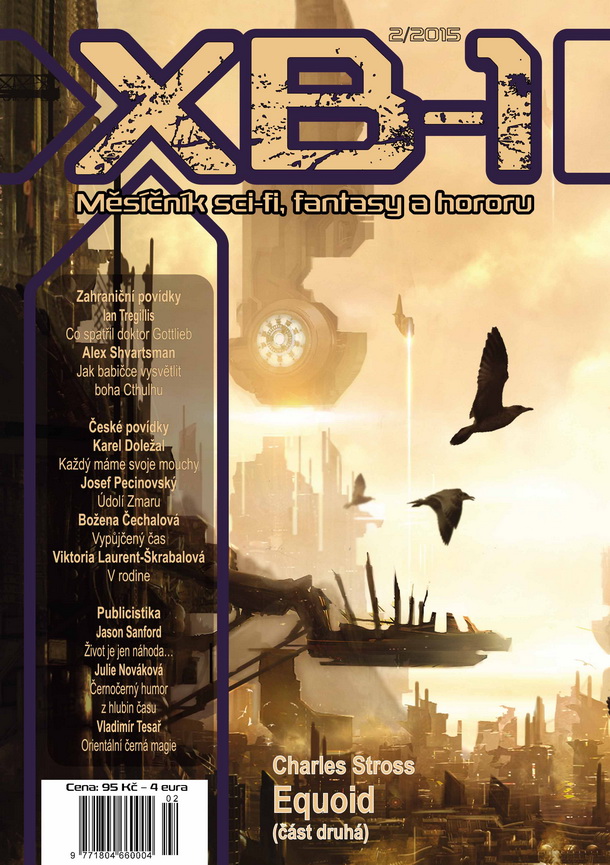
The February issue of XB-1 is coming soon a it features the second part of Equoid (Charles Stross), Explaining Cthulhu to Grandma (Alex Shvartsman) and What Doctor Gottlieb Saw (Ian Tregilis) in the foreign stories section. And with so much horror, humor ranging from the darkest tones to the lighter ones and a lot of lovecraftian world, it would be impossible not to build on it in the nonfiction section. Therefore my article “The Darkest Humor from Deep Spacetime” on Lovecraftian pastiches, with emphasis on the ones containing an element rarely if ever found in Lovecraft: humor.

There are hundreds or thousands of pastiches, many of them more or less humorous, some even parodies. But there are two great fiction series I’ve encountered that managed to convey deep horror and despair and season it with moments of wonderful, mostly very dark humor without making the horror seem any less serious, each series in its own brilliant way. One of them are Laundry Files by Stross. Equoid is a part of that series, among more shorter works, but be sure to try the novels as well. The other one is the Johannes Cabal series by Jonathan L. Howard. It’s composed of short stories as well as novels too and again I can recommend reading everything of it.

In light of unseen terrors and gloom, on the very verge of madness, there still can be something to laugh at. And where you’ve got laugher, you’ve got an even tiny spark of hope. Maybe that’s why the combination of true horror and humor works so well.

2_2015a.cdr

The Writing Workshop in Prague

Are you an aspiring author writing in English and based in Prague, and want to join a workshop to improve your craft? You might consider the Writing Workshop, an initiative founded by a successful SF writer and friend of mine, Jan Kotouč. He’s been running the workshop for two years by now and starting with this year, he’s expanding and offering more courses and classes by more lecturers. Jan is teaching the Intro to Creative Writing, Public Speaking and Press Releases. Our marketing expert Honza Felt teaches Internet Marketing for Writers. These are all one-day courses. The six-lesson Creative Writing workshop is taught by Jan and me. We’ll also start offering courses on book promotion and publishing in speculative fiction magazines (by yours truly).

Anyone can join the upcoming courses – the only requirement is being able to communicate in English. We’ve already had students from Russia, Latvia, Finland, Fiji, Croatia and other countries and we are always looking forward to meeting students from the whole world!


Warning: A non-numeric value encountered in /data/www/20562/julienovakova_com/www/wp-content/plugins/ultimate-social-media-icons/libs/controllers/sfsi_frontpopUp.php on line 63